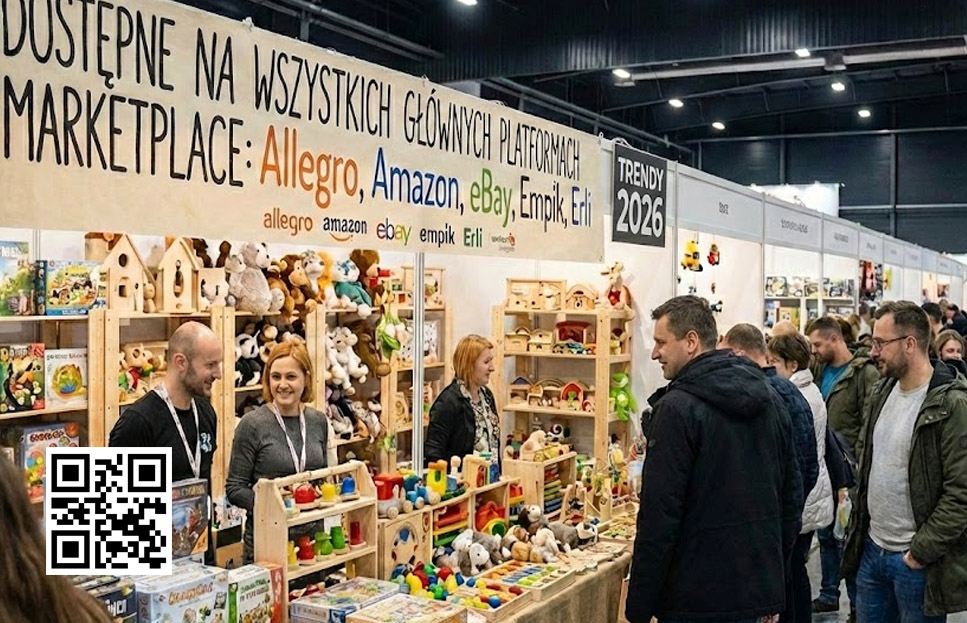
The toy sales market in Poland and Europe is undergoing one of the biggest transformations in the history of online commerce. Marketplaces have ceased to be just an additional sales channel and have become the primary shopping destination for parents. In 2026, this is where the most traffic, the most competition and the greatest sales opportunities are concentrated.
The growing dominance of marketplaces in toy sales is the result of several parallel phenomena. Consumers have become accustomed to one-stop shopping, comparing offers in real time and making decisions based on reviews. Proprietary stores still matter, but it is sales platforms that are taking a major role in generating volumes.
Allegro remains the main sales channel for toys in Poland. For many brands and stores, it is a primary source of revenue, not just a supplement to sales. The visibility of listings, the availability of the Smart program, logistics and customer feedback directly affect sales performance in the children's category.
At the same time, other platforms are growing rapidly. Empik Marketplace is attracting customers interested in educational and gift products, Kaufland is expanding cross-border sales and European reach, and Erli is growing due to aggressive pricing and low barriers to entry for retailers. In 2026, toy sales are rarely limited to a single marketplace - channel diversification is becoming the dominant model.
Price comparison sites and shopping systems are also becoming increasingly important. Ceneo and Google Shopping are becoming the first stage of the purchasing decision. Parents start the selection process by checking price, availability and reviews, and only later move on to a specific sales platform. Visibility on comparison sites today directly affects traffic and conversions.
Consumer behavior is also changing. Purchases are faster, more impulsive and based on product availability "here and now." Price still matters, but reviews, photos, delivery and seller credibility are equally important. Parents expect immediate order fulfillment, clear information and transaction security.
This post examines what the toy marketplace looks like in 2026, what trends are dominating, which categories are growing fastest, and what sales strategies will be important for eshops, importers and brands. It's a look based on market data, consumer behavior and the direction of children's e-commerce.
Marketplace as the main sales channel for toys
The toy market has undergone one of the most rapid transformations in the entire e-commerce sector in recent years. Marketplace platforms (such as Allegro, Amazon, or Empik Place) have ceased to be merely an "add-on" to a brand's stationary sales or online store. For many entities, they have become a a central operational hub, generating from 60% to even 90% of turnover.
This dominance is not accidental. It is due to economies of scale and the fact that the marketplace has become a natural product search engine - today's consumer often skips Google, typing the name of the toy they are looking for (e.g. "LEGO Star Wars" or "Barbie") directly into the search bar of the sales platform.
Changing shopping model of parents
Today's parents are a consumer group that values most time and convenience. The "trip to the toy store" model has become an occasional pastime rather than a way to store regularly.
- Mobile shopping (M-commerce): Purchasing decisions are often made "on the go" - in the waiting room, during a break at work or in the evening on the couch, using a smartphone. Marketplace apps are usually better optimized in terms of UX (user experience) than average mobile stores.
- Multi-basket shopping cart: Parents prefer platforms where they can buy a toy for their child, a supply of diapers and a book for themselves in one transaction and one shipment (such as Allegro Smart).
- Seasonality and impulsiveness: During periods such as Children's Day or Black Week, parents look for inspiration. Recommendation algorithms ("Others have also bought...") work much more effectively here than traditional store maintenance.
Why marketplace wins over own stores
Although owning your own online store (e-store) builds brand and loyalty, in the battle for "cold traffic" (new customer) the marketplace has a significant technological and budgetary advantage.
- Barrier to entry and trust: A new e-commerce store has to pay for customer acquisition (Google Ads, Facebook Ads) and convince the customer that the transaction is safe. The marketplace gives security guarantee (Buyer Protection Program), what with expensive sets of blocks or electronics for children.
- Ready customer base: By entering the marketplace, the seller gains access to millions of active users. In an in-house store, he has to build traffic from scratch.
- Technology and stability: During the peak season (November/December), small stores' servers often can't handle the load. The giants' infrastructure is up to the task.
Importance of seller reviews and rankings
In the children's industry Trust is the currency with the highest exchange rate. A parent will not buy a product that is suspected of being a fake or dangerous to health.
- Social Proof: Feedback from other parents ("Toy sturdy, survived throwing," "Blocks fit perfectly") are more important than a professional product description prepared by a copywriter.
- Visibility algorithms: The position of an offer in the search list (listing) is directly correlated with the seller's rating. Even the best price will not compensate for a low rating of service quality.
- Photos in reviews: The ability for buyers to add photos (UGC - User Generated Content) allows to verify the real appearance of a toy, which drastically reduces the number of returns.
Price pressure and logistics
Marketplace is an environment with near-perfect price competition, which raises specific challenges.
- Price transparency: Customers can sort offers from the cheapest with a single click. This forces sellers to continuously optimize margins and use tools like repricer (automatically changing prices in response to competitive moves).
- Logistics as part of the offer: Price alone is not enough. Very important is delivery time. Next day delivery ("Next Day Delivery") has become the standard. A vendor that offers shipping in 48h often loses out to a more expensive offer that guarantees delivery "tomorrow."
- Fulfillment: To meet these demands, an increasing number of toy companies are opting to outsource logistics (e.g., One Fulfillment by Allegro or Amazon's FBA), handing over warehousing and packaging to the platform to gain better bid positioning.
Sellers who combine competitive pricing with good logistics and service gain an advantage. In 2026, these are the elements that determine success in selling toys on the marketplace.
Allegro - still the leader in toy sales
Despite growing pressure from global players (Amazon) and Chinese platforms (Temu, AliExpress), Allegro remains the undisputed leader in toy sales in Poland. For the Polish consumer, Allegro is synonymous with safety and predictability. In the "Child" category, the platform not only sells, but acts as a trend finder, it's where parents check what's trending, how much it costs and whether it will arrive in time for the birthday.
Allegro's strength comes from habit (network effect) and unrivaled logistics (parcel machines), which in the minds of Poles is inextricably linked to this platform.
Toy categories with the highest traffic
Traffic on Allegro in the toy category is strongly correlated with the calendar and pop culture trends, but certain segments enjoy consistently high interest.
- Legos (LEGO Dominance): This is the category generating the highest turnover. Customers here are looking for specific set numbers. The battle for customers here is mainly over price, as the product is standardized.
- Board games i educational: Poland is a market where board games are experiencing a renaissance. Allegro is the main sales channel for both big publishers (Rebel, Trefl) and niche developers.
- Interactive toys and electronics: Robots, interactive mascots or educational tablets. Here, novelties promoted on TV and YouTube play an important role.
- Garden toys (Seasonality): From March to June there is a surge in sales of trampolines, garden houses and swimming pools - these are high-margin products, but difficult in logistics (dimensions).
The importance of Smart!, delivery and reviews
In the Allegro ecosystem, the loyalty program Smart! is no longer an option, but a a necessity. Listings without the Smart! are often automatically filtered by buyers (more than 70% of users use this filter).
- Free delivery as standard: Customers don't want to pay for shipping, especially for purchases over £45. The lack of Smart drastically reduces conversion.
- Speed (Delivery Tomorrow): In the toy category, time is critical. Parents often buy gifts at the last minute. An offer with guaranteed "tomorrow" delivery (especially to Parcel Post) wins out over an offer that is 5-10 PLN cheaper, but with delivery in 3 days.
- Credibility of reviews: Allegro is strict about its rating system. In the children's business, negative reviews regarding, for example, a damaged box (which disqualifies a toy as a gift) can "kill" sales of a given listing for weeks.
Fight for Buy Box and visibility of offers
With the implementation of the Allegro Product Catalog (based on EAN codes), the sales model has become similar to the one known from Amazon. Sellers are no longer just competing with their own listing, but are fighting to be plugged into the main product card.
- Productization: A seller must link his listing to the Allegro catalog. If he fails to do so, his listing loses visibility.
- Top Offer (Buy Box): When several sellers offer the same LEGO set, Allegro singles out one (usually the one with the best combination of price, service quality and delivery time). It is this offer that garners about 80-90% of the clicks from the product card.
- Allegro Ads: Organic visibility is not enough. To break through the clutter of thousands of listings, sellers need to invest in sponsored listings and display ads, which raises the cost of customer acquisition (CAC), but is necessary to build scale.
How competition is changing in the children's segment
The market is maturing and professionalizing, eliminating casual players.
- Market consolidation: Small ("garage") sellers are finding it difficult to maintain Allegro's quality standards and price pressure. Large wholesalers and specialized e-stores with warehouse automation are taking over the market.
- Official Brand Stores: More and more manufacturers (e.g. Mattel, Hasbro) are opening their "Brand Zones" on Allegro. Although they rarely fight on price (so as not to spoil the market for distributors), they build image and trust there.
- Cross-border competition: Sellers from China are increasingly active on Allegro, offering cheaper substitutes for popular toys. Although the delivery time is longer, the low price attracts a segment of price-sensitive customers.
In 2026, the winners will be those who combine three elements: product availability, offer visibility and customer trust. Allegro remains the leader, but at the same time it is becoming a platform that requires more and more knowledge, strategy and sales professionalization.
Empik Marketplace, Kaufland, Erli - growing alternatives.
Although Allegro holds the palm of primacy, the e-commerce market in Poland has become fragmented. Relying solely on one sales channel has become business risky. Alternative marketplaces are no longer mere "add-ons," but specialized channels for reaching specific target groups that offer lower customer acquisition costs or higher average basket value.
Empik - a premium and educational customer
Empik Place is a platform with completely different characteristics than Allegro. Because of its pedigree (a bookstore), it attracts a customer looking for intellectual and developmental value.
- Customer profile: This is an informed parent or gift buyer, often with a higher disposable income. He or she is looking for creative toys, educational toys, board games (hobby segment) and premium building blocks.
- Higher average basket value: Empik customers often add a toy to a book or CD, which increases the value of the order. Program Empik Premium works similarly to Smart, building loyalty.
- Assortment selection: Empik focuses on quality. Cheap, plastic "no-name" toys sell less well here. It's an ideal place for brands such as LEGO, Ravensburger, Djeco and Janod. The platform is perfect as a channel for higher-margin products, where price is not the only selection criterion.
Kaufland - cross-border and European scale
Kaufland Global Marketplace is a powerful tool for retailers who want to go beyond Poland without having to build overseas structures.
- Gateway to the West (and South): One integration allows you to sell not only on Kaufland.co.uk, but especially on Kaufland.de (one of the largest marketplaces in Germany), as well as in the Czech Republic (Kaufland.cz) and Slovakia (Kaufland.sk).
- Brand trust: As a marketplace chain, Kaufland enjoys great trust. For a Polish toy retailer, this is an opportunity to sell, for example, wooden toys or Polish board games to German customers who are able to pay more for them (price arbitrage).
- Operating model: Kaufland takes over marketing and payment processing in foreign currency. The retailer's role is only to ensure fast overseas shipping and translate descriptions (often supported by platform automations).
Erli - aggressive pricing
Erli is positioning itself as a cheaper alternative to Allegro, openly battling the giant with lower commissions for sellers, which is expected to translate into lower prices for buyers.
- Low-cost strategy: Erli offers programs in which it lowers a seller's commission if he or she offers a price lower than in other channels. In the toy industry, where margins can sometimes be "razor-thin" (e.g., on popular building block sets), any percentage savings on commission is at a premium.
- Partnership with InPost: Strong integration with Parcel Post and free delivery (Erli Pro) make the shopping experience almost identical to the market leader, but often cheaper.
- "Smart Shoppers" base: Erli attracts bargain hunters. It's an excellent channel for selling off end-of-series (outlet) and marketing cheaper replacements for popular toys.
Diversifying sales as a 2026 strategy
Looking ahead to 2026, the "single-channel" model (Allegro only or own store only) is a high-risk strategy. A system failure, account lockout or sudden algorithm change can cut a company off from revenue overnight.
- Centralize inventory: The key is to use integrators (such as BaseLinker) that allow you to manage all marketplaces from one panel. Selling the last piece of a toy on Empik must immediately close out the offer on Allegro and Kaufland to avoid selling an item that is out of stock (overselling).
- Margin optimization by channel: The 2026 strategy is to control price by channel.
- News and Premium -> Empik / Own Store (higher margin).
- Volume and Rotation -> Allegro (economies of scale).
- Sales and Price Fight. -> Erli.
- Exports -> Kaufland / Amazon.
- Business security: Presence on 3-4 platforms gives stability. A decrease in reach on one platform is often compensated for by an increase on another, thus maintaining liquidity.
In the years to come, it will be the multi-channel sellers who will build the advantage. Marketplaces are no longer competing solely with online stores, they are beginning to compete with each other, and the winners are those who can take advantage of their diversity.
Here is an analysis of the trends shaping sales on marketplace platforms in 2026. The toy market has evolved from simply providing entertainment to a hybrid model combining education, mental health and advanced technology.
Key trends in toy marketplace sales 2026
The year 2026 in toy e-commerce is marked by conscious parenting i hyper-personalization. Marketplaces have ceased to be just a place for price battles; they have become platforms where parents look for solutions to specific parenting or developmental problems. The winners are those sellers who can properly tag their products, fitting into niche but highly profitable micro-trends.
Educational and developmental toys
This category has undergone a transformation from the general buzzword "education" to precisely targeted support for future competencies.
- STEAM 2.0: Kits for learning coding (often without screens), robotics and engineering are no longer niche. They're standard in school supplies. Keywords such as "logical thinking," "modularity" and "physics for kids" are important on Allegro and Amazon.
- Emotional support (EQ): In response to the growing awareness of children's mental health, toys that teach emotion recognition, mindfulness and stress regulation are a hit. Stress-relief plushies or therapeutic games are seeing triple-digit sales increases.
- Eco-awareness: "Green toys" are no longer just wooden blocks. They are toys made of bioplastic and recycled materials. Parents on marketplaces are increasingly filtering offers by eco-certifications (FSC, Blue Angel).
Smart toys and technology products
Toys in 2026 are "connected." The boundary between the physical and digital (Phygital) worlds is blurring completely.
- AI in the child's room: Interactive teddy bears and robots using simple language models (LLM) can carry on a natural conversation with a child, tell personalized stories or teach foreign languages in real time.
- Augmented Reality (AR): Traditional puzzles and books come to life when a tablet is pointed at them. Retailers need to remember to include in the product gallery videothat demonstrates this mechanism; static photos alone no longer sell these products effectively.
- Data security: In the auction description, further confidence-building element is the information that no internet connection is required (offline mode) or data encryption. Parents are sensitive about privacy.
Outdoor and seasonal toys
As a counter-trend to digitization, the "back to nature" and physical activity segment is growing.
- Micromobility: Electric scooters, skateboards and cross-country bikes for the youngest is a category with a high basket value (High Ticket). Here logistics are very important, offers with free courier delivery (Smart!/Prime) are winning, despite the large size.
- Sensory gardens: Mud kitchens, sensory paths and advanced playgrounds for self-assembly. Customers are looking for durable, weather-resistant products (searches: "treated wood," "UV-resistant").
Viral products (TikTok, YouTube)
The sales dynamics in this category are unpredictable and instantaneous. Marketplace here is just a "cash register" for demand created in social media.
- Kid-fluencer effect: If a popular creator on YouTube Kids shows a new form of "squish" or collectible figurine, demand on the marketplace grows vertically within 24 hours.
- Short life cycle: These products have huge margins at the beginning of the trend and a sharp drop in price once the marketplace is saturated. Sellers must monitor hashtags (e.g., #tiktokmademebuyit) and respond with immediate air imports to time sales.
- Blind Boxes: Mystery boxes with random contents are a gambling mechanism carried over into the toy world that continues to drive huge sales volumes among older children.
Premium and gift toys
In this category, price plays a secondary role. What matters are aesthetics, branding and the "unboxing experience."
- The "Kidults" (Adult Children) phenomenon: This is the fastest growing demographic group. Adults are buying themselves expensive brick sets (LEGO Icons), collectible models and premium board games. They are looking for products that look good on the living room shelf.
- "Instagram" aesthetics: Toys in muted, pastel colors (beiges, sage) that suit modern interiors. Flashy, plastic colors are rejected in this segment.
- Gift-ready: The "gift-wrap" option on Allegro or Amazon is a standard in this category, which often determines the choice of the offer.
Marketplace market data and statistics (2024-2026)
The years 2024 and 2025 were a period of stabilization after the pandemic boom, and 2026 brings a clear rebound in the value of the shopping cart. The toy market in Poland and Central and Eastern Europe (CEE) is growing, but this growth is mainly driven by unit price inflation and a change in the demographic structure of shoppers, rather than a dramatic increase in the volume of items sold.
Marketplace's share of e-commerce sales
The marketplace model has become the dominant e-commerce format in Poland. According to Strategy& reports (PwC network) and PMR data, the share of marketplace platforms in total online sales in Poland is steadily growing.
- Dominance of the model: In 2024, marketplaces were responsible for approx. 63% value of the total e-commerce market in Poland. Forecasts for 2026 indicate that this figure will increase to a level close to 68-70%.
- Consumer preferences: Research shows that more than 80% Internet users start their search for a product by typing a phrase into a marketplace search engine (Allegro/Amazon), skipping Google.
- Consolidation: The three largest platforms (Allegro, Amazon, Chinese players like Temu/AliExpress) concentrate more than 3/4 of the traffic in the "Baby" category.
Growth of the children's category
The toy category (Toys & Games) is one of the pillars of e-commerce, but its structure has changed dramatically between 2024 and 2026.
- Market value: According to Circan (formerly NPD Group), the toy market in Poland in 2025 recorded a value growth of approx. 4-6% y/y, despite a decline in the number of births.
- The "Kidults" phenomenon: This is the most important statistic in recent years. Adults buying toys for themselves (over the age of 12 or 18) already account for nearly 30% of the turnover of of the entire industry. It is this segment that generates the largest margins (collectible LEGO sets, premium board games, figurines).
- Average basket value (AOV): In the marketplace channel, the average value of a toy basket increased from about PLN 110 in 2023 to nearly PLN 145 in 2026 (estimates based on inflation and premiumization trends).
Seasonality of toy sales
The toy industry is characterized by one of the highest amplitudes of seasonality in all retail. The sales graph resembles a "U" with a very high peak at the end of the year.
- Q4 is the base: The last quarter of the year generates from 40% to as much as 55% of of annual turnover in the toy category.
- Second Peak (Q2): Spring (May-June) is the second most important period, accounting for approx. 20-25% of annual sales, driven by outdoor toys and family occasions.
- Dead season: January and February are the "shopping hangover" months, where sales drop to 30-40% of the monthly average, and returns and exchanges of misplaced gifts dominate.
The strongest months and shopping bargains
Analyzing data from platforms such as IdoSell and BaseLinker, one can pinpoint the precise moments when marketplace servers heat up.
- November and December (Absolute Peak):
- Black Week (late November): This is the moment when parents buy more expensive gifts (electronics, large sets of building blocks), taking advantage of promotions.
- December 6 (Santa Claus): Generates a huge volume of small toys up to PLN 50-70.
- December 10-18: Last call before Christmas - impulse buying with guaranteed fast delivery dominates.
- May (Communion Season and Children's Day):
- Increase in sales of expensive products: drones, electric scooters, advanced LEGO Technic, educational laptops.
- The end of May sees mass purchases for Children's Day (June 1).
- September (Back to School):
- Although associated with school supplies, it generates a lot of traffic in the following categories: educational games, globes, microscopes i creative kits.
Data from sales platforms show that toy sales can increase several times during peak periods compared to "quiet" months. This is why planning assortment, logistics and marketing campaigns around the shopping calendar is becoming part of the sales strategy.
Statistics clearly show that marketplaces have not only taken over toy sales, but also shaped their rhythm. Sales grow where three elements come together: season, product availability and offer visibility.
How do parents in 2026 buy toys?
A parent in 2026 is "Smart shopper" in an extreme version. This is a digital consumer who no longer separates the online and offline worlds. Toy shopping is a continuous process, woven into daily activities. The shopping path is rarely linear, starting with inspiration on TikTok or Instagram, moving through a quick price comparison on a marketplace app, and ending with a one-click payment on the way to preschool.
Without a doubt, the currency for this group is time. Every second of delay in loading an offer or complicated return form is a risk of cart abandonment.
Mobile first
In 2026, the slogan "Mobile First" has evolved into "Mobile Only" for the children's category. The desktop computer is used by parents for work; the smartphone is the command center for family life and shopping.
- App dominance: Over 85% of transactions in the toy category are finalized on mobile devices. Parents prefer marketplace apps (Allegro, Amazon, Empik) over mobile versions of websites, due to memorized payment and shipping data.
- Vertical content format: Listings are consumed in a manner similar to social media browsing. Main images must be readable on a small screen, and descriptions condensed (bullet points).
- Instant payments: No BLIK, Apple Pay or Google Pay in 2026 is tantamount to losing a customer. A parent doesn't have time to enter a credit card number.
Decisions based on reviews
Trust in brand advertising has fallen to historic lows. In 2026, a parent trusts another parent. Reviews are filtered by sophisticated algorithms that catch fake reviews, which increases their credibility.
- Video reviews (UGC): A textual "recommend" review is not enough. Buyers are looking for photos and short videos added by other users, showing the real size of the toy and its features.
- Sustainability rating: In an era of environmental awareness and inflation, parents are looking for information on the durability of product. Phrases in reviews such as "the wheel fell off after a day" or "poor quality plastic" are disqualifying, even at a low price.
- Q&A on the product card: The Q&A section, where users (or the vendor) dispel doubts (e.g., "Does it fit X set?"), is often read more carefully than the manufacturer's description.
Shopping "here and now"
The culture of immediacy (Instant Gratification) has caused the time window for delivery to shrink dramatically. The Q-commerce logistics model has affected expectations of standard shopping.
- "Same Day" and "Next Day" delivery: The market standard in major cities is same day (when ordering in the morning) or next day delivery. Offers with a 48h+ shipping time are considered "custom goods" and often overlooked.
- Late Cut-off: Parents buy late in the evening, after their children have gone to sleep. Vendors who offer same-day shipping for orders placed by 8pm or even 10pm (thanks to fulfillment services) win the "Buy Box."
- Precision: More important than speed is predictability. The information "Delivery on Tuesday between 10:00 a.m. and 12:00 p.m." is worth more than the generic "Delivery in 1-2 days."
Trust in the marketplace
Marketplace in 2026 serves as a An institution of public trust. A parent would rather buy a toy more expensively on Allegro/Amazon than cheaper from an unknown online store, risking problems with returns or data security.
- Transaction security: Buyer protection programs provide assurance that if you receive a counterfeit or damaged item, a refund will be automatic.
- Easy returns: No need to print a label (QR code in Parcel Post) is an absolute requirement. Parents often order two similar toys to choose one and send the other back, the marketplace must make this easy, not difficult.
- One basket: The ability to buy a toy, home chemistry and a book in one transaction (Smart!) builds loyalty to the platform, not a specific seller.
What will sell best in 2026?
The year 2026 is when the toy market will finally move away from cheap plastic "at once." Consumers, tired of over-stimulation and low quality, are looking for products "High Value", ones that engage a child for hours, grow with him or her, or have a high resale value (resell value).
Educational and STEM toys
The STEM (Science, Technology, Engineering, Math) category has evolved into a STEAM (Arts has been added) and in 2026 is entering the phase of AI-Integrated.
- Robotics with AI: It's not just simple "go straight" coding anymore. Modern educational robots use simplified artificial intelligence modules, learning a child's reactions. Kits that allow you to build your own "assistant" are a hit.
- Biology and Ecology: "Zero Waste" experiment kits, homemade hydroponic greenhouses or microscopes that connect to a smartphone. Parents are eager to invest in toys that explain climate change and the natural world.
- Construction Blocks 2.0: Sets that are LEGO-compatible, but offer motors, sensors and AR apps that "bring to life" built models on a tablet screen.
This is a dominant category during the communion and "Christmas" season (as a major gift from the whole family).
- 24V and 36V vehicles: The market is shifting toward more powerful batteries. Parents are looking for cars that can handle rough terrain (grass, hills), not just pavement.
- Drift Carts: Electric drift karts for older children (ages 8-14) are an absolute sales hit, bridging the gap between toys and "real" motoring.
- Safety (Parental Control): An important sales feature is an advanced app for the parent to remotely disable the vehicle ("Kill Switch") and set a geolocation speed limit.
Creative kits
The answer to digital overdrive. Parents are looking for toys "Slow Play", which calm and teach patience.
- DIY (Do It Yourself) and Crafts: Professional jewelry-making kits (child-safe epoxy resin), pottery or crochet. This is the result of trends from TikTok (#crochet, #pottery).
- Sensorics for older kids: New-generation plastic masses (non-staining, color-changing when exposed to heat) and ASMR kits (sound sensory toys).
- Customization: Kits for painting clothes (sneakers, jackets) or creating your own cosmetics (bath balls, soaps).
License products - Forecast for H2 2026
Licensing is fuel for e-commerce. The retailer that first puts out products from an upcoming blockbuster movie rakes in a novelty premium.
Key licensing trends for Q3 and Q4 2026:
- Gaming enters cinema (The "Minecraft" Effect): Following the success of the Mario and Sonic movies, 2026 belongs to game adaptations.
- Forecast: Everything related to Minecraft (live-action film/new updates) and Roblox (figurines with codes for the game - so-called. virtual items) will sell instantly. The physical toy must give a bonus in the digital game.
- The return of Giants of Animation:
- Expect premieres from Disney/Pixar (potentially sequels to Iceberg Land or Toy Story - release cycles point to major releases around Thanksgiving/Christmas).
- Shrek 5 / Dreamworks: If rumors of a 2026 release are confirmed, the green ogre will dominate the plush and figure market in Q4.
- Anime Mainstream:
- One Piece i Naruto are the new "Star Wars" for the Alpha generation. Gadgets, collector cards and figurines from the Japanese animations will move out of the niche into supermarkets and onto the mainstream pages of Allegro.
- Streaming Series (Netflix/Disney+):
- Watch for the premieres of new seasons of hit shows like Wednesday or Stranger Things (or their sequels). Merch "dark/gothic" for teenage girls is a vein of gold.
Seasonal hits
Seasonality in 2026 is even more pronounced and abbreviated.
- Spring/Summer (Garden):
- Water obstacle courses: Bouncy castles and water slides for the garden.
- Eco-bubbles: Soap bubbles in biodegradable packaging and reusable water balloons (resealable with a magnet) that eliminate the problem of plastic trash in the garden.
- Fall/Winter (Advent Calendars):
- This is a category that is growing by double digits. It's no longer about chocolates. The hits are calendars with toys (LEGO, Funko Pop, cars, Schleich figures) and DIY calendars for self-filling. Sales of this category start in September!
The biggest challenges of toy sellers on the marketplace
Selling toys on platforms such as Allegro and Amazon is a constant balancing act between sales volume and preserving margins. In 2026, the technology that helps sell has simultaneously become a weapon that can eliminate weaker players.
Price pressure
This is the most common reason for bankruptcies in the industry. Customers have access to excellent comparison sites, and platforms promote the lowest price.
- Algorithmic warfare: Automated tools (Repricers) scan competitor prices every few minutes and lower their own by a penny. This leads to a spiraling price drop (Race to the bottom), often below the break-even point, especially with high marketplace commissions (reaching 10-15%).
- The "Add-on Item" effect: Inexpensive toys (up to £30-40) become unprofitable to sell by mail order as individual items due to rising packaging costs and logistics "minimum fee".
Copying offers
In an era of globalization and easy importation, product uniqueness is short-lived.
- Product hookups: On Allegro (Product Catalog) and Amazon, if you build the popularity of a particular toy, competitors with the same EAN code will "hook up" to your product card. All your work on positioning and images will be taken over by someone who offers a price 50 cents lower.
- Chinese direct competition: Factories that produce toys for Polish brands often enter the marketplace themselves (D2C model - Direct to Consumer) through cross-border platforms (e.g. Kaufland Global, AliExpress), offering the same goods without the middleman's margin.
Returns and customer service
The Baby category is one of the most demanding in terms of returns (Return Rate).
- Damaged packaging: For a customer (especially a gift buyer), a crumpled corner of a LEGO box disqualifies the product. This generates a huge number of returns of merchandise that is technically in working order, but commercially becomes an "outlet."
- Seasonal "rentals": The phenomenon of buying expensive carnival costumes or large garden toys for one event and then returning them under the 14-day right of withdrawal.
Logistics and delivery
In 2026, the standard is Q-commerce (Quick commerce).
- Late Cut-off: Customers expect a toy ordered at 10pm to arrive the next day. Small warehouses cannot operationally meet these demands without expensive outsourcing (Fulfillment).
- Dimensional costs: For large toys (houses, battery-powered vehicles), storage and custom shipping costs rise disproportionately to the price of the product, eating into margins.
How to increase toy sales at Allegro, Empik, Kaufland and Erli?
To survive, a retailer must stop being a "stocker" and become an expert at marketing and optimizing its offerings. Here are tactics that work.
SEO of product listings on the marketplace
Search engine algorithms on marketplaces (Allegro relevance, Amazon's A9) work differently than Google.
- The title is no place for creativity: It must contain keywords in order from the most important (Brand -> Type -> Model -> Features). E.g.. "LEGO City 60139 Mobile Police Command Center Blocks." is better than "Super boy set of Police bricks"..
- Parameterization: In 2026, side filters (Age, Gender, Hero, Material) are very important. Completing 100% of the parameters in the listing form increases bid visibility by up to 30%, as the auction "catches on" to all user filters.
Sales photos and videos
Customers buy with their eyes, and in the case of toys, with their emotions.
- Product scale: A photo of a toy on a white background is not enough. It is necessary to have a photo of the type lifestyle with a child that shows the real size of the product. This eliminates negative feedback like "I thought it would be bigger."
- Video presentations (Rich Content): A short, 15-second video in the gallery (autostarting), showing the toy's features (sound, movement, light up), dramatically increases conversions. On Empik and Amazon, the "A+ Content" section (extended graphic description) is mandatory for premium products.
Bundling and bundling
The only effective way to escape the price war and direct 1:1 comparison.
- Logic bundles: Instead of selling "Barbie doll," sell "Barbie doll + Clothes set + Brush." You create a new product code (often the set's own EAN) that your competitors don't have.
- Ready-to-play: For battery-operated toys, add... batteries. For bicycles - a helmet. Customers are willing to pay extra for the convenience and assurance that the gift will be ready to use right out of the box.
Pricing strategy
The price doesn't have to be the lowest, it has to be "smart".
- "Second Place" strategy: It often doesn't pay to fight for the Buy Box at any price. Being the second cheapest offer, but with a faster delivery (e.g., Allegro One Box / Parcel Post for tomorrow) or a better store rating, often gives a better margin while maintaining satisfactory volume.
- Dynamic margin: During the peak season (December), when popular toys disappear from the market, you should raise prices, rather than lowering them. The last pieces of blockbusters even sell at a 50-100% margin when parents are desperate for the lack of availability from competitors.
Feedback and customer service
In 2026, customer service is the new marketing.
- Speed of response: On the marketplace, response time affects positioning. Using auto-responders and AI templates for immediate responses is standard.
- Crisis management: When dealing with negative feedback, the key is not to argue, but to respond publicly, professionally and (often) offer compensation. Customers read negativity to see how a vendor handles problems - if they see class and a willingness to help, they are more likely to take a chance on a purchase.
Good customer service translates into trust, and trust translates into sales. In the marketplace, this is often more important than price alone.
Marketplace strategy for a toy store for 2026
In 2026, winning on the marketplace is not about "hand-holding." A successful strategy is A symbiosis of technology and analytics. A toy retailer is no longer just a salesman - it becomes an operator of a complex data system. Success depends on the speed of information flow between the warehouse, wholesaler and sales platform.
Multi-channel (Omnichannel 2.0).
Basing a business on a single channel (e.g., Allegro only) is a gamble in 2026. A multi-channel strategy is about diversifying risk and maximizing reach, but managed from one place.
- Operational centralization: The heart of the business must be an ERP system or integrator (e.g. BaseLinker, Linker Cloud) that acts as a "command center." Inventory must synchronize in real time between Allegro, Amazon, Empik, Erli and the in-house store (Shopify/PrestaShop/IdoSell).
- Offer segmentation: Not every channel is for every product.
- Allegro/Amazon: Bulk products, "traffic builders," price war, fast turnover.
- Own store/Empire: Premium products, limited editions of LEGO, wooden toys, private labels - this is where we build margin and loyalty (LTV - Lifetime Value).
- Image consistency: A customer who finds a toy on the marketplace often searches for it later on Google to check out the store. Consistent naming and branding across all channels builds the trust necessary to complete the transaction.
Price automation (Repricing AI)
In a category as price-sensitive as toys, a static price is a dead price. In 2026, algorithms, not humans, will manage prices.
- Robot warfare: Repricers (price-changing robots) are no longer just for lowering the price. Modern AI tools can raise the pricewhen they detect that competitors have sold out (out-of-stock) or when a shopping "peak hour" is approaching (e.g., Sunday evening).
- Margin protection: The key is to set "hard stops" (minimum price) below which the system will never go, taking into account the channel's commission.
- "Buy Box" strategy: On Amazon and the Allegro Catalog, the goal is not to be the cheapest in general, but to be the cheapest among the listings eligible for free and fast delivery. The algorithm must understand this.
Integrations with wholesalers
The dropshipping or "virtual warehouse" model in 2026 requires ironclad data discipline. Marketplaces mercilessly punish order cancellations due to out of stock.
- Mapping and updating: XML/API integration with the wholesaler must take place more than once a day. During peak season (November/December), inventory updates need to flow every 15-30 minutes.
- Smart buffer: If the wholesaler shows 5 pieces of a popular doll, your system should display a maximum of 2 pieces on the marketplace. This is a "safety cushion" to protect against overselling (selling an item that the wholesaler no longer has).
- Feed selection: It is no trick to pull 50,000 products from the wholesaler (the so-called "junk listing"). The strategy is to filter the listing - importing only those toys that have high quality images, full descriptions and EAN, which guarantees a better position in search results.
Scaling up sales
Once the domestic market saturates, the only direction for growth is geographic and logistical expansion.
- Cross-border (Going abroad): With Allegro (Czech Republic, Slovakia, Hungary) and Amazon (Germany, France, Italy), a Polish toy store can become a European player without opening foreign offices. This only requires translating offers (often automatically) and adjusting delivery price lists.
- Logistics Outsourcing (Fulfillment): To scale sales in Q4 (holidays) without hiring an army of packers, it is necessary to switch to the Fulfillment model (One Fulfillment by Allegro / FBA Amazon). Goods are shipped directly from the platform's warehouse, which gives the offer priority in display and a "tomorrow" delivery guarantee.
- Paid campaigns (Ads): Organic reach is not enough. Scaling up requires a budget for Allegro Ads / Amazon PPC. In 2026, an investment of 10-15% of revenue in ads is the market standard, necessary to maintain the "flywheel" of sales.
The future of the online toy market
The evolution of toy commerce is moving toward a model of "Predictive & Immersive Commerce".. Stores cease to be passive catalogs and become active assistants that "know" that your child has just outgrown Duplo bricks and needs the first LEGO City set before you think of it yourself.
AI on sale
Artificial Intelligence in 2026 is no longer a novelty, but a fundamental operating engine (backend) of every major player.
- Generative descriptions and SEO: Sellers no longer write descriptions by hand. AI generates unique, keyword-rich content for thousands of products in seconds, tailoring the tone (tone of voice) to the specific platform (a different description on Allegro, another on TikTok).
- Visual search (Visual Search): Parents are increasingly looking for toys by taking a picture at another person's house or in a stationary store. Algorithms recognize the product (even by a snippet) and find the cheapest deal online in a split second.
- Return prediction: AI analyzes the customer's history even before the purchase. If the system detects a high return risk (e.g., a customer serially orders and returns), it may not offer him free delivery or hide the cash on delivery option.
Personalization of offers
The era of mass marketing in the children's industry is over. The time of Hyper-personalization based on behavioral data.
- A store that "grows" with the child: Marketplace algorithms create a profile of a child's "digital twin." If you bought a layette for a newborn, in 6 months the system itself will suggest sensory toys, and in a year - a running bike. The home page of the store for each parent looks different.
- Dynamic Bundles (Smart Bundles): The system sees that you are looking at a doll you bought a year ago, and instead of suggesting it again, it suggests matching clothes or furniture from a new collection ("Complete the set").
- Perfect Gifts: The AI-based "Gift Finder" function allows you to type in your child's interests (e.g., "dinosaurs, space, 7 years old") and receive a list of 3 sure-fire gift picks with guaranteed success, based on trend analysis and reviews by other parents.
The growing role of video
Static photos are becoming insufficient in the toy industry. Video is becoming the main medium of information, and the line between entertainment and shopping is blurring completely (Shoppertainment).
- Live Commerce (Live Shopping): Broadcasts, during which presenters test toys and viewers can buy a product with a single click without leaving the stream, are standard in the pre-holiday periods.
- Video reviews in listings: Platforms such as Amazon and Allegro give a premium to listings that have an "unboxing" or "how-to-play" video in the gallery. Customers want to see how loud the toy is and how complicated it is to assemble.
- Interactive ads: A video format in which clicking on a toy that a child is playing with on screen takes them directly to the shopping cart.
Marketplace ecosystem
Marketplaces aim to lock the user into a "golden cage" (Walled Garden).
- Super-apps: Allegro or Amazon are not just stores. They are ecosystems that offer financing (PayPo/Allegro Pay), toy insurance (e.g., from drone destruction), and even video content (Prime Video) for children.
- Loyalty over price: Subscription programs (Smart!, Prime) mean that the customer no longer looks for deals on Google. He only looks for them inside the app he pays subscription for, even if it's cheaper elsewhere. Convenience and free delivery win out over lower product prices.
- Integration with the home (IoT): Ordering toy batteries or blocks via voice assistants straight from the living room is becoming a natural shopping reflex.
This is the summary of the entire 2026 toy market analysis. It provides a bracket for all the trends and strategies discussed earlier.
The era of marketplace dominance in the toy industry
2026 is not just another year on the e-commerce calendar. It is a watershed moment in which the toy sales model has finally crystallized. Marketplace platforms have ceased to be mere virtual marketplaces; they have become sophisticated technology ecosystems that dictate the playing field for the entire industry: from manufacturers to distributors to the end customer.
Marketplaces will dominate toy sales
For the modern parent, Allegro, Amazon or Empik have become the "default search engine." The convenience of a single shopping cart (Smart!), security of transactions and speed of delivery have relegated independent online stores (e-stores) to the role of niche boutiques.
- Centralization: Marketplace is no longer just a sales channel, it is an operations center. This is where decisions are made about what is fashionable (trendy) and what is going away.
- Barrier to entry: Whoever is not visible on the marketplace, for the mass customer basically does not exist.
Competition will increase, but the market will also grow
The paradox of 2026 is that while the battle for customers is tougher than ever, the "cake" to be shared continues to grow.
- New players: Factories from China have entered the market directly (D2C model), as well as big brands that previously sold only B2B.
- New segments: The market is not shrinking, but evolving. The decline in births is being compensated by the growing purchasing power of the segment of Kidults (adult collectors), the popularity of toys STEM/AI and premium products. The winners will be those who stop fighting for the "cheapest rattle" and start selling "development and excitement."
Vendors with data, logistics and content will win.
In the age of algorithms, there is no room for intuition. Market leaders in 2026 are basing their success on three pillars:
- Data (Data-Driven): They know what to sell before competitors notice a trend. They use analytical tools to accurately manage price and inventory.
- Logistics (Fulfillment): They understand that "delivery tomorrow" is a standard, not a luxury. For them, outsourcing the warehouse is a way to scale peak season sales without congestion.
- Content (Video and SEO): They sell with images and words. Their offerings are mini-media presentations that answer every parent's question before the parent has time to ask it.
2026 = the year of professionalizing online toy sales
The time of "accidental sellers" is over. 2026 is the year of professionalization. The market has purged itself of players who could not take care of the quality of service, consistency of offerings or automation of processes. The best are left, those who can combine technology (AI, automation) with a human approach to the customer (trust, advice). They are the ones who will shape the future of the industry in the coming decade.



![Zabawki Black Week, Friday 2025: Polujemy na auta na akumulator, quady i gokarty! [TOP Promocje]](https://ramizb2b.com/upload/stblog/1/601/2240/6012240thumb.webp)


![Pojazdy na akumulator – jakie wybrać do miasta, a jakie na wieś? [Przewodnik dla rodziców]](https://ramizb2b.com/upload/stblog/1/534/1972/5341972thumb.webp)


